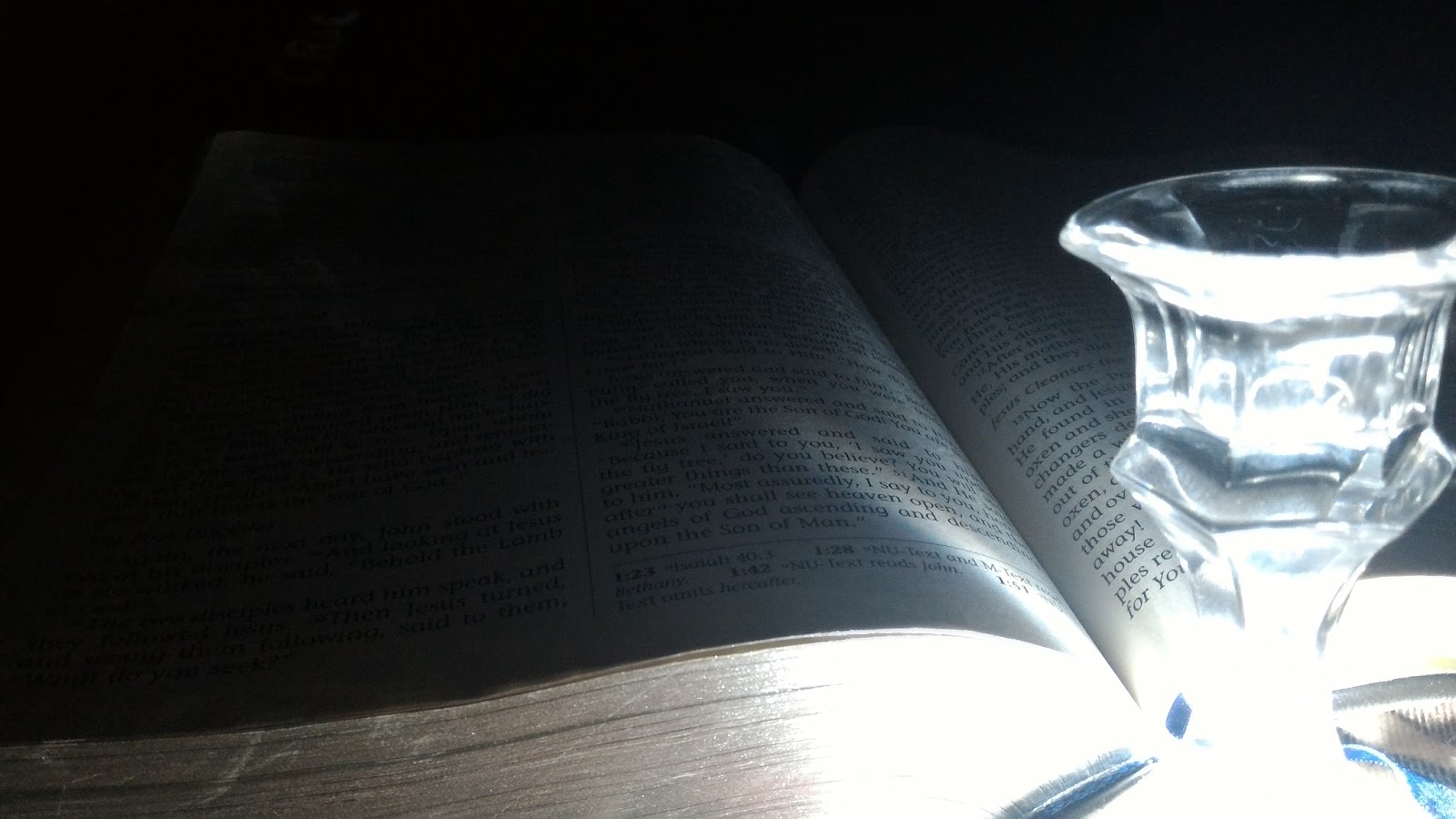
Firmly Planted Through Meditation

... he meditates day and night, he is like a tree planted by rivers of water that yields its fruit in its season, and its leaf does not wither. In all that he does, he prospers.Psalm 1:3

Last time I wrote about the blessed man who trusts in God, and who has confidence in God, for he is like a tree planted by waters, he will not be fearful nor anxious when the heat and drought comes.* Today we see another man who is blessed like a tree planted by waters. The first man is blessed, he is firmly planted through trust and confidence, with roots deep and connected to a source of continuous living water, he will prosper. 

The second man is also blessed, he delights in the word of God, he meditates on it continuously, he will be like a tree planted by the rivers of water, that brings forth its fruit in its season, whose leaf shall not wither; and whatever he does shall prosper.

With my whole heart I have sought you; oh, let me not wander from your commandments! Your word I have hidden in my heart, that I might not sin against you... I will meditate on your precepts, and contemplate your ways. I will delight myself in Your statutes; I will not forget your word. Deal bountifully (deal fully; wean, grow up; ripen, bear fruit; prosper) to your servant, that I may live and keep your word.*

How can a young man cleanse his way? by taking heed according to God's word, with the whole heart seeking, not wandering, but hiding his words in the heart so that they might not sin against God. Such a man will rejoice in His testimonies more than riches and will meditate (which means to engage in contemplation or reflection, to focus one's thoughts on: reflect on or ponder over, to plan or project in the mind : intend, purpose) on His word and contemplate (think profoundly and at length) His ways, delighting and not forgetting His words.* One can be firmly planted, cleanse his way, by seeking God with a whole heart, by meditating, and contemplating on His word.
You will keep him in perfect peace, whose mind is stayed on you because he trusts in you.*
It begins with renewing our minds to trust and have confidence in God. Transformation continues as we meditate on God and His words. Have you ever used wikihow.com? it has step by step instructions with pictures. It was interesting when I found wikihow.com instructions for meditating on God's word.* Meditation and contemplation is a powerful tool God uses in transformation, the renewing of the mind. If you are struggling in an area, meditate on scriptures related to your area of struggle. If you need strengthening in faith, meditate on the word of God, faith comes through the word of God. If you are struggling with hopelessness meditate on hope. If you are struggling with sexual immorality meditate on scripture related to this. Don't just read it once, but over and over, meditating on it. God uses scripture to renew our minds, as Jesus said if we abide in the truth it will set us free. To be firmly planted, meditate on foundational things like adoption, redemption, forgiveness, read over and over scriptures like Ephesians chapter 1. Read, meditate on scriptures about justification and righteousness in Romans, over and over again. Pray for God to show you scriptures to meditate on. 

Therefore if raised along with Christ, seek that above where Christ exists enthroned at the right hand of God. Have the mind of above, not that of the earth, for you died and your life is laid up together with Christ in God. When Christ your life is brought to light then you also will be brought to light with him.*

Renewal gives us the mind above, the mind of the new man, who is a new creation in Christ. So when we have this mind, we have put on the new man, the one raised and seated with Christ. If you are raised with Christ, Paul writes, then seek that above. What part of me has been raised with Christ? It is not my body, we are awaiting a salvation; the redemption of our bodies.* There is a salvation of our soul, the goal of faith Peter writes. It must be the new man, the spiritual man? Paul writes part of us is raised and seated with Christ, we are made alive "and raised us up and seated us in the heavenly realms in Christ Jesus,"* In context, Paul is talking about if we have been raised, think on things above, put off the mind of the old man and put on the mind of the new man. The new man is the one that is above, so we want to have his mind so that the life of Christ is brought to life in our bodies.*

Finally, brothers, whatsoever is true, whatsoever is honorable, whatsoever is just, whatsoever is pure, whatsoever is lovely, whatsoever is commendable, if anything is excellent also if anything praiseworthy, think (regard, consider, ponder, meditate, reason) such things.*

You have to be persistent in renewing the mind. The carnal mind is against God and this weakness the devil takes advantage of to war against our mind, our souls. Since the goal of our faith is this salvation of our souls, renewal of the mind is very important* It's really about being conformed to the image of Christ, that which God purposed before the creation of the world and why He chose us. We need to have the new mind, that of above. Give me bread and living water so that I might prosper in your ways so that I might be firmly planted by living water and bear fruit in season. 

Meditate on these things; coming into existence in them, so that your advancement is visible to all.*

Meditation helps in transformation, it is coming into existence, putting on the new man, through the renewing of the mind. When we have the mind above, the peace of God will guard our hearts and minds in Christ Jesus.* What we think about determines whether we will have the mind of the new man or that of the earthly. Know your thoughts, as Joyce Meyer writes in her book Battlefield of the Mind, "think about what you are thinking about." When we are trained by the words of faith, we are trained in godliness, able to discern and reject silly myths and more serious, the teachings of demons and deceitful spirits.* Meditating on the word of God advances us into maturity, empowering us to grow strong in the Lord in the might of His strength. We can put on the armor of God to stand against the schemes of the devil. John writes, when the word of God abides in us we are strong and will overcome the evil one. Meditation on the word, helps us grow strong in the Lord.

Let the words of my mouth and the meditation of my heart be acceptable in your sight, O Lord, my strength and my Redeemer.*

Meditation keeps us on the path of righteousness, so we do not walk in the advice of the ungodly, nor journey with the sinful, nor assemble with those who despise the wisdom of God.* Meditating on His words brings the wisdom and understanding of God.* And it helps us to speak wisdom and give understanding.* It helps us contemplate His ways.* It keeps us from being arrogant, and helps us to overcome those who wrong us.* Meditation helps us be watchful in the night.* "Be sober-minded; be watchful. Your adversary the devil prowls around like a roaring lion, seeking someone to devour."* Meditation includes remembering the "days of old" when God had his hands on us working out things for our good.* Remember the good things of the past, when God stretched out his hands to us, doing mighty deeds and miracles in our lives.* Meditating on His words is life and even health to one's whole body.* 

In the new testament, the word of God became flesh and dwelt among us.* So we can say, blessed is the man whose delight is in Jesus, the word of God in which he meditates day and night, "he is like a tree planted by rivers of water that yields its fruit in its season, and its leaf does not wither. In all that he does, he prospers."*

Popular (last 30 days)

Blessed Are The Forgiven

Blessed! the one whose lawless deeds are forgiven and the one whose sins are covered over, blessed is the man whom sin, the Lord will not consider . * Paul writes David foresaw and spoke " blessed is the one whose transgression is forgiven, whose sin is covered . *  Blessed, is the one whom sin is not considered, this word considered  means "to credit, count, reckon, to set down as a matter of account; regard, think, consider." This blessing comes through faith and according to grace, " also David speaks of the blessedness of the one to whom God considers righteousness apart from works ." *  The word for  lawless deeds speaks of the violation of the Law and the word for sin  speaks of missing the mark of God's righteousness. Blessed are those who (by faith in Christ according to grace) have been forgiven. In Him receiving the redemption through his blood, the forgiveness of trespasses according to the riches of His grace . * This fundamental ...

All Who Are Thirsty

“ Come, everyone who thirsts, come to the waters;  and he who has no money,  come, buy and eat!  Come, buy wine and milk  without money and without price.  Why do you spend your money for that which is not bread,  and your labor for that which does not satisfy?  Listen diligently to me, and eat what is good,  and delight yourselves in rich food. .." (Isaiah 55). " Come, buy wine and milk without money and without price ." Buy is defined as to acquire the ownership of by giving an accepted price or consideration therefore; to accept or believe as true .[ 1 ] When we buy something we consider the price that we must pay, we accept this and purchase the thing we have considered worthy of the sacrifice we make in payment. W e can not buy, with money or price, redemption from t his tragic flaw we are born into. However Jesus paid the price for us, so we buy or accept through consideration, the Greek word is  logizomai.[ 2] ...

Spirit of Life

" Indeed, the law of the Spirit of Life in Christ Jesus liberates from the law of sin and death ." 1 This word for liberates "I free, set free, liberate" is from a root word meaning free, exempt, not bound by an obligation. As partakers of God's divine nature, being born of Spirit, we are no longer obligated to the sinful nature but to righteousness which is God's nature. When we believe we receive the Spirit of promise, a guarantee of our inheritance, a great testimony that we are His children, it is a Spirit of Life. " Truly, truly, I say to you, whoever hears my word and believes him who sent me has eternal life. He does not come into judgment, but has passed from death to life." 24 The Son came not to condemn the world but to save it. "One trespass   led to condemnation for all men, so one act of righteousness leads to justification and life for all men. " 6 " He was delivered over to death for our trespasses and wa...

Lord, Stand By Me

"... present yourselves to God as those who have been brought from death to life, and your members to God as instruments for righteousness ." 1 This word for present means "I bring, present, come up to and stand by," it is parístēmi (from pará, "from close-beside" and hístēmi, "to stand") – properly, stand close beside, i.e. ready to present (exhibit). I pray Lord stand by me which expresses that I put my trust in Him, or I come up to and stand by Him. We use phrases like surrendering or bowing at the cross to explain such a moment, surely it is a coming to the end of ourselves and it is desirable that I find His will acceptable, but it is important to understand that it is about trust, not my will power, the key is that it is in Christ. The terminology the scriptures use is "present yourselves to God," or come up to and stand by and walk with Him. "... present your bodies as a living sacrifice, holy and pleasing to God--this...

The Tripartite Nature of Humanity: Spirit, Soul, and Body

The Tripartite Nature of Humanity: Spirit, Soul, and Body in Biblical Understanding The human being, as depicted in the Bible, is a multifaceted creation, often understood through the distinct yet interconnected components of spirit, soul, and body. While some theological perspectives lean towards a bipartite view (soul and body), which we do see in the Old Testament, a careful examination of the New Testament scripture reveals a compelling case for a tripartite understanding, where each is divided into or composed of three parts. Let’s explore the biblical distinction between spirit, soul, and body. The Body: Our Earthly Vessel The body is the physical form that interacts with the material world. From the very beginning, Genesis 2:7 states, " Then the Lord God formed man from the dust of the ground and breathed into his nostrils the breath of life, and the man became a living being ." This verse clearly establishes the body's origin from the earth, emphasizing its connec...

A Better Hope: A Cleansed Conscience

The journey of the human conscience begins in the Garden of Eden. When Adam and Eve partook of the tree of the knowledge of good and evil. This specific knowledge of good and evil in regards to the conscience became the internal witness for all mankind, distinct from the written Mosaic Law given later to the Jews. Paul affirms in Romans 2:15 , this conscience functions as a law within, bearing witness even in Gentiles who lack the written code. Initially designed to guide, this faculty immediately revealed guilt, as Adam and Eve "knew that they were naked" ( Genesis 3:7 ). While the conscience ( syneidēsis ) acts as a witness, bearing testimony, the suppression of truth leads to a darkened internal state. In Romans 1 , we see the tragic progression of humanity knowing God but refusing to glorify Him, resulting in their "foolish heart" being "darkened" ( Romans 1:21 ). This internal darkness that resulted from mankind "searing the conscience" laid...

Freedom from the Mosaic Law: A Deep Theological Exploration of New Testament Teaching

  Freedom from the Mosaic Law: A Deep Theological Exploration of New Testament Teaching Introduction: The Question of the Mosaic Law and Christian Identity One of the most significant theological debates and practical challenges for the early church was the place of the Mosaic Law in the life of believers in Jesus Christ. This question remains alive today, particularly in communities and churches that quote the Old Testament as if its legal prescriptions still directly obligate Christians. The apostolic writings, especially those of Paul, provide the primary lens through which the New Testament resolves this matter. Paul’s letters—rich in both theological reflection and ecclesiastical urgency—not only confront false teaching but chart the path of new covenant living by the Holy Spirit.  This essay seeks to offer a doctrinal synthesis on why believers are no longer “under the Mosaic Law,” supported by original-language insights, harmonized scripture references, and commentar...

A Better Covenant: Maturity in Christ

In the landscape of modern spirituality, there is a pervasive misconception that maturity is measured by activity—that the more one serves, the more mature one is or becomes. However, the Apostolic witness suggests a radically different metric. Maturity, or "perfection" ( teleiōsis ), is not the accumulation of religious duties or the adherence to external written codes, precepts, or principles. Wisdom is not reflected by adherence to elemental principles nor even proverbs but in how we grow in Christ, who is our wisdom from God (1 Corinthians 1:29-30). Maturity is a transformation where the believer is conformed to the very life and nature of Jesus. The Inability of Service to Mature The Epistle to the Hebrews provides a rigorous critique of the Old Covenant system. The Levitical priesthood was defined by constant service, sacrifice, and ritual. Yet, the writer argues that this ceaseless activity failed to achieve God’s ultimate goal for man: perfection. Hebrews 7:11 (Li...

The Superior Ministry

The transition from the Old Covenant to the New is not merely a change in administration; it is a fundamental shift from shadow to substance, from external laws to internal transformation. Hebrews 8 provides the theological anchor for this shift, presenting Jesus Christ not just as another priest, but as the Mediator of a completely superior arrangement established on better promises. The Mediator of a Better Covenant The writer of Hebrews draws a sharp contrast between the Levitical priesthood and the ministry of Jesus. We see this explicitly in Hebrews 8:6, where the superiority of Christ's work is defined by the quality of the covenant He mediates. Hebrews 8:6 (MOUNCE Interlinear) "Now at present, he [Christ] has obtained a superior [ diaphorōteras ] ministry [ leitourgias ] the covenant [ diathēkēs ] he mediates [ mesitēs ] is better [ kreittonos ], since it is enacted [ nenomothetētai ] on better promises [ epangeliais ]." The word diaphorōteras (more excellen...

Doctrinal Deep Dive: Maturity in Christ

The New Testament repeatedly asserts that true spiritual maturity is not merely intellectual assent or ritual observance, but a Spirit-enabled transformation into the likeness of Jesus Christ .  This doctrinal deep dive explores the thesis that any doctrine or teaching which does not lead to such maturity is, by biblical definition, deceitful or immature , as Paul warns in his letters. Our study harmonizes key scriptural passages— Hebrews 6:1–3, Ephesians 4, James 1, the Parable of the Sower (Matthew 13, Mark 4, Luke 8), Ephesians 3, and Colossians 2 —and conducts detailed Greek word studies to clarify the biblical vision of maturity, perfection, and rootedness in Christ. We will contrast true maturity with false or immature teachings, drawing on historical theology and providing reproducible teaching resources for practical application. I. Harmonization of Key Scriptures on Maturity in Christ A. Hebrews 6:1–3—Pressing On to Maturity Hebrews 6:1–3 stands as a pivotal exhortatio...