Now who is there to harm you if you are zealous for what is good? But even if you should suffer for righteousness' sake, you will be blessed. Have no fear of them, nor be troubled, but in your hearts honor Christ the Lord as holy, always being prepared to make a defense to anyone who asks you for a reason for the hope that is in you; yet do it with gentleness and respect, having a good conscience, so that, when you are slandered, those who revile your good behavior in Christ may be put to shame. For it is better to suffer for doing good, if that should be God's will, than for doing evil..1
 The presumption of innocence means the burden of proof is on he who declares, not on he who denies. This is often expressed in the phrase innocent until proven guilty. It is a principle that many believe was introduced by the Romans but I believe it has its roots in Christianity, it is a principle that is not perfect but works. In a court of law the burden of proof is on the prosecution, it is their job to collect evidence, facts that the accused is guilty beyond reasonable doubt. If there is reasonable doubt then the accused is acquitted.
Jesus said to be careful as to how you judge as it will be measured back to you the same way you measure to others. This idea of not judging without substantial gathering of facts is Biblical. And the idea of conflict resolution is spoken of by Jesus. if your brother sins against you, go and tell him his fault between you and him alone...6 Here the word for sin is hamartanó, I miss the mark, hence (a) I make a mistake, (b) I sin, commit a sin against God or against someone.7 This conflict resolution is when someone breaks the greater principles of love, not just for transgressions. The biblical model says you confront in private, then do mediation with witnesses, if you allow accusations without such a process you have thrown out this idea of presumption of innocence, allowing hearsay, gossip. One must have the fortitude to stand for truth.
A system that assumes guilt is a society that favors the wealthy. If I am poor and I am accused I most likely do not have the resources to prove innocence. If I am poor and I want to accuse a wealthy person of guilt I must only gather the facts. It is facts that do away with reasonable doubt. If I am wealthy I can influence people to my side, so a system should always set out to protect the poor. Under such protection judgement is based on facts and there is no reasonable doubt. Of course there will always be exceptions, money can buy better attorneys. To assume innocence puts the burden on the accuser to prove guilt. Such a system has been proven over time and works under a moral democracy.
Oh to know that relationship is valued over rules even by God, it is his Golden Rule which sums up the law, this is evident in the son who, in the story of the prodigal son, followed all his fathers commandments, but did not love his brother. Let your kingdom come, let your will be done, as in heaven also on earth.7
Prepare The Way
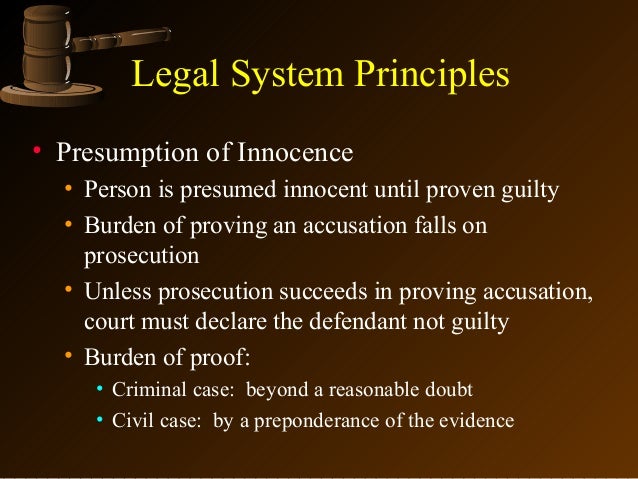
When society becomes such that one is guilty until proven innocent, then we throw out several thousand years of wisdom and build upon a shaky foundation. Judgement can be passed on people without any factual evidence, and doing such opens the doors to all kinds of accusations and slander. People will be attacked by certain groups just based on motivation that is political, greedy, or just spiteful. To deny someone their inalienable rights is to operate against justice. Hearsay and accusations will become the norm. But understand this, that in the last days there will come times of difficulty. For people will be lovers of self, lovers of money, proud, arrogant, abusive...2
While our system is not perfect it works to provide equal rights. I should not have to prove my innocence, proof lies on him who asserts, not on him who denies. This would seem to protect the guilty but in fact it is meant to protect both sides until sufficient evidence is gathered to either acquit or guilt. Without this foundation in place people can make false accusations against anyone without any accountability. It is a burden to prove guilt because it should be, the burden is less likely to be taken if there is no truth in the claim. But even so, for righteousness sake, Blessed is the man who remains steadfast under trial, for when he has stood the test he will receive the crown of life, which God has promised to those who love him.3
So speak and so act as those who are to be judged by the law of liberty. For judgment will be merciless to one who has shown no mercy; mercy triumphs over judgment.4 The law of liberty says we are to not serve our fleshly desires but to serve one another.5 Freedom is about helping others be free, For whatever overcomes a person, to that he is enslaved. The devil is a liar, an accuser, and a condemner, he wants us to be like him. But the one who looks into the perfect law, the law of liberty, and perseveres, being no hearer who forgets but a doer who acts, he will be blessed in his doing. God gives us mercy though we deserve judgement, it is His way.
While our system is not perfect it works to provide equal rights. I should not have to prove my innocence, proof lies on him who asserts, not on him who denies. This would seem to protect the guilty but in fact it is meant to protect both sides until sufficient evidence is gathered to either acquit or guilt. Without this foundation in place people can make false accusations against anyone without any accountability. It is a burden to prove guilt because it should be, the burden is less likely to be taken if there is no truth in the claim. But even so, for righteousness sake, Blessed is the man who remains steadfast under trial, for when he has stood the test he will receive the crown of life, which God has promised to those who love him.3
So speak and so act as those who are to be judged by the law of liberty. For judgment will be merciless to one who has shown no mercy; mercy triumphs over judgment.4 The law of liberty says we are to not serve our fleshly desires but to serve one another.5 Freedom is about helping others be free, For whatever overcomes a person, to that he is enslaved. The devil is a liar, an accuser, and a condemner, he wants us to be like him. But the one who looks into the perfect law, the law of liberty, and perseveres, being no hearer who forgets but a doer who acts, he will be blessed in his doing. God gives us mercy though we deserve judgement, it is His way.
Jesus said to be careful as to how you judge as it will be measured back to you the same way you measure to others. This idea of not judging without substantial gathering of facts is Biblical. And the idea of conflict resolution is spoken of by Jesus. if your brother sins against you, go and tell him his fault between you and him alone...6 Here the word for sin is hamartanó, I miss the mark, hence (a) I make a mistake, (b) I sin, commit a sin against God or against someone.7 This conflict resolution is when someone breaks the greater principles of love, not just for transgressions. The biblical model says you confront in private, then do mediation with witnesses, if you allow accusations without such a process you have thrown out this idea of presumption of innocence, allowing hearsay, gossip. One must have the fortitude to stand for truth.
Oh to know that relationship is valued over rules even by God, it is his Golden Rule which sums up the law, this is evident in the son who, in the story of the prodigal son, followed all his fathers commandments, but did not love his brother. Let your kingdom come, let your will be done, as in heaven also on earth.7
Prepare The Way